It was a first for me: an extended road trip/book tour, 15 different events in 16 days, taking me from Lexington Virginia to California, Oregon, Ohio, and back to Lexington. Thanks to the many folks whose hard work, planning and good will made it a success! Here is a brief and incomplete photographic scrapbook:
1. January 16, 2013: Reading at Washington and Lee, in Hillel House, with colleagues, friends, and Margo. Photos courtesy of Patrick Hinely, W&L photographer! Looking at these pictures of myself, I see a happy woman. Is that what it looks like when the Ancestors are shining through me?
 |
| This is what a well-funded Native American academic looks like! Thanks, Washington and Lee University! And thank you to my colleagues, friends and students who came out to hear me, especially after listening to me talk about this book for oh, maybe 10 years. That's real dedication, folks. Give yourselves a hand. |
2. The next morning I hopped on an Oakland-bound plane in Roanoke, taking off around 5:30 a.m. Westbound travel is a tough start, but it's sooooo nice to arrive on the West coast with an "extra" 3 hours! Time enough to rent a car at the Oakland Airport, get lost (my GPS was willing to switch over to California, but not willing to give up the 'no freeway' command), find my hotel in San Francisco, check in, change clothes, and still make it to my 6 p.m. reading at the California Historical Society. A terrific audience, lots of great conversations, and afterwards, dinner with Lindsie Bear and Malcolm Margolin of Heyday, and an unforgettable walk through the Tenderloin to my hotel with two very faithful escorts.
Some of the things I saw that night will never leave me. A man making his bed on the sidewalk. Not off to the side or in a doorway: but right in the middle of the sidewalk. Communities living in cardboard boxes. The line outside a homeless shelter going around the block. Stepping carefully over a woman's legs as she sat against the wall with her pit bull asleep at her side. The smell of cigarettes, spilled wine, urine, salt air and dampness. The next morning, I woke to my yellow orchids from Malcolm and Lindsie dancing in the sun like little whirling Sufi dervishes.
3. A day of rest, much welcomed after 2 events 3000 miles apart. I woke to a beautiful sunrise over the Tenderloin District.
Coffee and a shower were followed by the keeping of a promise: I had allowed myself to be 'auctioned off' as a Heyday fundraiser, and so was teaching a writing workshop for ten of Heyday's supporters at a house out in Mill Valley. I was delighted to discover that getting to this site was a treat in itself:
 |
| walking down to Market St. and catching a trolley to the Ferry Building down on the Embarcadero |
 |
| Discovering it was the Saturday Farmer's Market ... |
 |
| buying a small, gluten-free quiche for my breakfast and eating it outside on a bench under the clock tower and crisp blue skies... |
 |
| then a sweet ferry ride out to Sausalito ... |
 |
| and a drive up into the redwoods to our host's home near Mt. Tamalpais. |
...and a wonderful writing workshop with a group of women who came bearing notebooks, pens, laptops, and FOOD! Delicious potluck lunch, followed by lots of hot tea and some deep, serious, free writes in the shadow of those towering redwoods and that mountain that looks like a sleeping lady. I have several poem starts from that workshop, and was witness to some beautiful images.
 |
| What a wonderful group of women writers! Thank you Marina, Susana, Susan, Kyle, Joan, Laura, Leanne, Lauren and Nancy! |
 |
| Collage of indispensable items so far: printed itinerary, Luna bars (never travel without food), ferry schedule, SF street map, hotel room key, abalone necklace for good luck and oh yeah - THE BOOK! |
4. From San Francisco, I drove to my sister's house in San Jose. Louise always has a bedroom ready for me. It was so good to talk over family and tribal business, eat the good food she cooks, and sleep, sleep sleep!
Louise accompanied me to UC Santa Cruz for a reading and a class visit, taking photos, selling books, and filling in the gaps during Q and A - a 2fer of Miranda sisters! My hosts - Carolyn Dunn and Amy Lonetree, along with their colleague Renya Ramirez (on sabbatical), have midwifed Bad Indians through the long years of its incubation, and it was a real homecoming to deliver the whole book in their presence. What a treat to have Scott Morgenson in the audience, too, on a visit to his old stomping grounds, and to meet Lisbeth Haas (Pablo Tac: Indigenous Scholar) for the first time - her book has meant so much to me. Beth took Louise and me out to dinner that evening, and talking California missions with her was pretty dang cool.

 |
| Signing a book for Renya Ramirez and Yvonne S. |
 |
| Carolyn Dunn |
 |
| The Sun! The Sun! |
|
 |
| Swilling that pink lemonade that felt so good on my dry throat... |
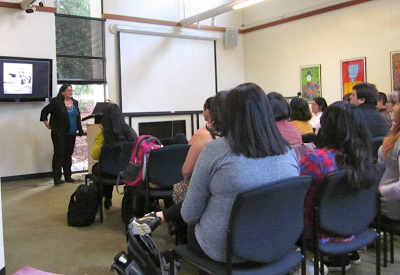 |
| Presentation of Bad Indians to students & faculty |
 |
| My Grand-niece, Alex, drove from Sacramento to be there! |
 |
| Louise J. Miranda Ramirez mans the book table armed with my iPad and a "Square" swiper - a blessing for authors on a book tour. |
|
5. The next day, Louise and I went back to UC Santa Cruz campus (we'd spent the night at the SC Best Western, where - amidst the Surfer Decor - we'd had to sign a "NO PARTYING" contract!), where I gave a PowerPoint lecture/reading about the history of the California missions to Jon Daehnke's class. Afterwards, we had lunch with students and faculty at the Ethnic Cultural Center. Good food, hard questions from students, heart-felt conversations about writing, teaching, grad school, the politics of being a passionate person of color, the challenges of claiming a Two-Spirit identity, and always, always, mutual expressions of admiration and respect. I hope that these students keep in touch with me.
 |
| Awesome UCSC students and faculty!!! Thank you for your generous hearts. |
And, as an added treat - seen at the UCSC Bookstore:
 |
| How Fire is a Story, Waiting by Melinda Palacio! It almost like seeing Melinda herself! |
6. After another night at Hotel Louise & Ernie in San Jose, I drove to Berkeley for the Pegasus Bookstore reading that Lindsie Bear was so helpful in setting up! Pegasus is the kind of bookstore I would have hung around as an undergrad - full of cool poetry, literature, ethnic studies and art books that make you just want to live in the stacks. It was a 7:30 p.m. reading, a beautiful rainy evening in Berkeley.
 |
| Bad Indians in some good company. |
The audience was lovely! I was thrilled to find authors and Macondistas Leslie Larson (
Slipstream and
Breaking Out of Bedlam) and partner Carla Trujillo (
What Night Brings, Chicana Lesbians: The Girls Our Mothers Warned Us About) in attendance, along with dear friends Keiko Lane (from long-ago Flight of the Mind Writing Workshops for Women at McKenzie Bridge, Oregon) and partner Lisa Denenham, as well as Beverly Slapin. Not to be outdone, my sister Louise's heart-sister Char came too, and brought her two sons, young Indian men, with her. It was an incredible evening of camaraderie. Afterwards, as I packed up to leave and most everyone had already gone home, I paused to chat with the folks at the counter, and left them a pile of Bad Indian postcards. A woman who had just entered the bookstore asked me about them, then about the book, then proceeded to buy one, tell me she teaches at Mills College, and planned to use Bad Indians in her classroom! I continue to be amazed at the power of author sales. I've sold copies of Bad Indians on planes, to taxi drivers, practically to random strangers. Those are the sales I really remember. I've also left copies for hotel maids and waitresses. It's that kind of book.
 |
| (not my photo; too rainy that day to get a good picture) |
I stayed that night at the
French Hotel in Berkeley - a very European-style hotel over their own coffee shop, with a tiny balconey, basic bed and bath, and just a few blocks from Pegasus. I wish I hadn't been so tired; I could have sat in the cafe and sipped coffee for hours the next morning! One of the owners greeted me with such helpful advice, and the other owner checked me out with a gracious invitation to come stay again. This is not a boutique hotel - it's plenty lived in, got lots of charisma and more than a few miles on it - but it is right downtown Berkeley and rich with characters. I loved it.
7. And then in the morning, back into the car, back onto the freeway, and back to San Jose to tape a session of Native TV with host Rose Amador (
click here to watch this episode). By this time, I have to admit, the cold that had been chasing me since about day 3 was coming in for the kill, and I was dragging the whole way in pouring rain. Thank goodness for GPS, which took me only a little off track before finding the studio, and for the kind crew on the set who found me a cup of tea, put makeup on me, arranged my microphone, and made me feel more than welcome. Since my mom worked at KOMO-TV in Seattle for over 20 years, being back in a TV station and behind the scenes felt very familiar. Being in front of the camera, not so much! The following photos are courtesy of Native TV.
 |
| Rose Amador preps me for the show. |
 |
| Donna Wallach gets the mike to stick! |
 |
| Lori Ramos Ehrlich was very concerned about my innate shiny-ness. |
 |
| Ah, the control room! This was where I liked to hang out with my mom at KOMO-TV. |
8.
Back over to Louise's house for lunch and a nice rest, then into the car again for a not-too-rainy drive down to Cal State University at Monterey Bay for a reading in the evening. Here, my voice really started to get ragged. But a nice mango-orange smoothie from the Starbucks in the Student Center got me through! Thanks to Tim Bill, who invited me, and to the students and other visitors who attended and with whom I had great conversations with afterwards. How amazing and strange it was to read about events involving my ancestors while standing on the very ground where much of those events happened...
 |
| photos by Louise J. Miranda Ramirez |
9.
Spent that night in San Jose with Louise and Ernie, and drove up to San Francisco around noon to check into my hotel and get ready for the evening's "Journeys of the Spirit" reading at The Women's Building with Kim Shuck, Indira Allegra, Jewell Gomez, and devorah major. I have long wanted to see this building in person, and it was simply stunning. I didn't take these photos, because it was just a little too dark; instead, I've gathered them from websites about the mural project. This must be one of the most gorgeous, most beloved buildings in the world. It's a Goddess of a building. And we got to read in it!


 |
| This has to be the most responsive, enthusiastic, loving audience I've ever read for. What an appreciative audience, all kinds of great gasps and ahs and oohs and mmmms for all of us! It was like having sound effects to the poetry. This was especially nice for me: I'm still learning how to read with my reading glasses on, which means when I glance up to make contact with the audience, I really can't see anyone's face. The little coo's and aw's really helped! (photo thanks to Lillian Fleer of Heyday) |
 |
| Indira and Jewelle (from a previous gathering - photo by Kima Jones. Due to a transportation mix-up, I was late to the reading, and missed all the pre-event schmoozing. Afterwards, we had only ten minutes for visiting before the building got locked up! So, I've borrowed photos of my sister readers just so readers can see their beautiful faces here. |
 |
| Kim Shuck |
|
 |
| devorah major |

10. Next day it was a short drive to Oakland, where I crashed for the afternoon at the home of Keiko and Lisa, dear friends who were off to a birthday party and left me to their sunny, peaceful home. I napped, drank more of Beverly's cough syrup, and by 4:00, I was ready for the reading at Oakland Genealogical Society - a place I'm pretty sure my mother must have gone on her research travels, and where my old friend Ellen Sacco-Fernandez, whom I met at least ten years ago at the NEA seminar at Evergreen State College, is now on the Board. Now these were people after my own heart - folks deeply immersed in the lives of their ancestors. And way more people showed up than Ellen anticipated. Two women said they saw the notice on the Heyday website, my cousin
Arleen and her wife Pam came, one young professor I'd met at MLA a few
years ago who had my chapbook & wanted to see the whole book - and
she brought 2 students, at least, with her. Three or four members of
CGS. Beverly. Ellen's husband Tom. A few others. A great audience,
more like a class. I read for an hour. Then Q and A for another hour. These are my peeps! Genealogy Geeks Unite! By the time it was all over, my poor voice was truly shot. I crept out to the parking lot, got into my rented Jeep monster, and drove back to Keiko and Lisa's. Those dear friends fed me hot, precious Pho, made me more Throat Coat Tea, and tucked me into bed with an electric blanket. But you know what? Being sick didn't matter to me. I had felt, once again during that reading at CGS, the Ancestors with me, lifting me. They had been with me the whole trip, even when I was at my lowest. And that's the whole point: love, pride, gratitude for the Ancestors.
 |
| Me and my Chumash cousin, Arleen. She brought her genealogy so we could see where we're related! |
 |
| I snuck this picture before everyone had arrived. By the time I got going, we'd had to borrow chairs from another room. Way to go, Ellen! (that's her on the far right) | | | |
|
|
 |
| Collage for the end of this part of the trip: business cards from
audience members at The Women's Building reading; a book by devorah
major that I swapped a Bad Indians for; hankerchief of dried sage from
the Native Voice TV crew; post cards, sweet note and card from Ellen
with an honorarium I'm almost completely sure came out of her own
pocket; and of course, Black Elderberry tincture for my cold (thanks
Beverly!). Don't leave home without it. |
11, 12 & 13. After a deep sleep, I woke to a lovely breakfast of hot oatmeal and coffee (thank you Lisa!!) and hugs all around before leaving for the Oakland Airport. Saying goodbye to my rental, I caught my flight to Portland Oregon. Rented another car, not nearly as much fun as the Jeep, to drive down to OSU in Corvallis. I read three times there: once at the Long House, followed immediately by a 2 hour visit to Qwo-Li's Queer Theory Lit class; and once for Margaret
-->
Mathewson’s
Contemporary Native American Issues class
the next day.
My son, Danny Miller, took the train down to Salem from Seattle, visited with a buddy of his, then caught a ride over to meet me at my hotel. It all went smoothly! How good to see him again! He still looks 12 years old to me, but he's really 23, and quite the grown up. He's working this year before starting grad school, but business is slow at the Space Needle in January, so we were able to squeeze in this visit. This really cheered me up! Danny also took these photos of the reading at the Long House on OSU campus for me.
 |
| Me with my friend and OSU host, Qwo-Li Driskill. |
 |
| The Long House is brand new - this was one of the first events - and this totem pole was an incredible presence. |
 |
| A collage of my OSU visit: throat lozenges, Osha Root cough meds, a beautiful basket woven by Qwo-Li, plane ticket, the necklace Margo made for Qwo, and book marks made by my sister Louise. It really does take a village to care for a poet. |
Danny and I drove up to Portland together, and I dropped him off at the Amtrak Station. He was heading back home to Seattle, and I was catching a plane to Ohio for a visit with Janet McAdams at Kenyon College. It was hard to say goodbye to my boy. He's such a kind, strong, smart person - we had some great conversations in our room and in the car (before he fell asleep, as he always does).
 |
| Yes, I'm cheating. This is Danny two years ago on a visit to Virginia. I can't believe I didn't take any pictures of us together. This will publicly embarrass me enough to not forget next time, I hope. |

14 & 15. By the time I hit Columbus, Ohio, I was actually feeling better. Maybe it was seeing my Danny, or hanging out with the awesome students at OSU; maybe it was just time for the cold to exit, stage left. And from here on out, the trip seemed much easier. Probably that was because I left my rental car in Portland and from there on out, I was cared for every step of the way. Someone else flew the plane, a driver met me at the airport and drove me the hour to Kenyon (I slept, like Danny, most of the way); and my host, Janet McAdams, made sure I had rides the whole time I was there. The best part was staying at Janet's house in her luxurious Poet's Apartment downstairs; even when the power went out for the entire second night, we were snug and cozy! Of course, part of that may have been the furry presence of Durga, Janet's dog, who snuck down to my bed ...
 |
| I read here ... |
 |
| I took few photos at Kenyon - you could tell it was the end of the trip. Stole this one of Janet from the KC website. |
 |
| One of Janet's gifted students made this poster - accidentally choosing one of the "Kids on Pony" photos from the blog instead of the book cover, but we decided we all liked it (and the kid is now a former colleague of Janet's, so it all worked out) |
My second day at Kenyon, Janet and I met up with
GLBTQ students for a discussion of Sovereign Erotics, as well as my article on the gendercide of the joyas in California. Several faculty members came too, and a former W&L professor who is now retired!
Ohio was cold, it snowed a bit; the little village of Gambier lost power one night, but Janet's house stayed nice and warm. We walked Durga, drank a lot of scrumptious tea that Janet provided, talked, went out for great meals with good people, and had a terrific time. In fact, I can't wait to go back and visit Janet again - I miss her warm and wise presence!
So that was my amazing journey - and one from which I am still recovering. Getting a cold while on a book tour must be part of the dues writers must pay; it helps a LOT to have good friends along the way who ply you with herbal remedies, pho, hot tea, warm beds and snuggly dogs (thanks, Ollie and Durga!). It was an adventure, especially for someone like me, who never really travelled until well into my 30s; hotels, rental cars, plane rides and restaurants are still big thrills for a kid from the trailer park. I felt so lucky to have this book out, and the way people have helped me welcome Bad Indians into the world has been one big gift. Thank you, everyone - and now ... on to March and April!
I'll be traveling to:
Boston for the AWP (signing books and manning the booth for Scapegoat Press), Charlottesville VA for the Virginia Festival of the Book (with Karenne Woods and Allison Hedge Coke), to Minnesota for the Native American Literature Symposium at Mystic Lake Casino, SUNY Syracuse to visit Jax Cuevas's classes, SUNY Oneonta with Susan Bernardin, then out to L.A. to read at Tia Chucha's Centro Cultural and Bookstore, Cabrillo College in Aptos, UCLA, the Salinas Public Library, and the Los Angeles Book Festival (where, if I don't get invited to read, you can find me haunting the Heyday booth!) at USC. See the "Readings & Reviews" tab for details!
Hope to see you there.


 Tuesday April 16th: Reading at UCLA (for UCLA faculty & students only), 12:30-1:45 p.m. 2209A Bunche Hall. Rebecca Rosser.


 Donna Miscolta, author of


